Mineral Help

What's New ] Axial Ratios ] [ Unit Cell Dimensions ] Chemical Formula ] Borax Bead Tests ] Phosphate Bead Tests ] Flame Tests ] Cleavage ] Color in Minerals ] Chemical Composition ] Crystallograpic Systems ] New Dana Classification Number ] Density of Minerals ] Diaphaniety of Minerals ] Dichroism ] Emperical formula ] Environments ] Crystal Forms ] Gladstone-Dale Relationships ] JCrystal Applet Crystal Forms ] jPOWD Structure Applet ] jmol Structure Applet ] Table of Mineral Habits ] Mineral Hardness ] Magnetic Properties ] Mineral Tenacity and Fracture ] IMA status ] Luminescence in Minerals ] Mineral Luster ] Name Origins ] Name Pronunciation ] Optical Data ] Pleochroism in minerals ] Mineral References Cited ] See Also ] Streak colors ] Fermion Index ] Radioactivity in Minerals ] Reflectivity in Minerals ] Reflection Anisotrophism ] Reflected Light Bireflectance ] Reflected Light Color ] Reflection Pleochroism ] Locality Information ] Synonyms of mineral names ] Strunz Classification ] X-Ray Diffraction ]

Unit Cell Dimensions

Definition

"The unit cell of a mineral is the smallest divisible unit of a mineral that possesses the symmetry and properties of the mineral. It is a small group of atoms, from four to as many as 1000, that have a fixed geometry relative to one another. The atoms are arranged in a "box" with parallel sides called the unit cell which is repeated by simple translations to make up the crystal. The atoms may be at the corners, on the edges, on the faces, or wholly enclosed in the box, and each cell in the crystal is identical. This is what was meant by an "ordered internal arrangement" in our definition of a mineral. It is the reason why crystals have such nice faces, cleavages, and regular properties." (Joe Smyth, University of Colorado)

The dimensions of the unit cell give its volume and are calculated as follows:

Crystal System Unit Cell Volume
Isometric V = a3
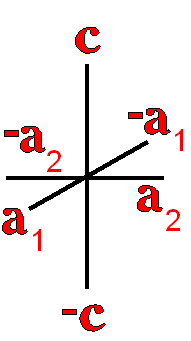
Tetragonal V = a2c
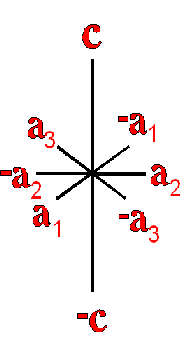
Hexagonal V = a2c sin(60°)
Trigonal V = a2c sin(60°)
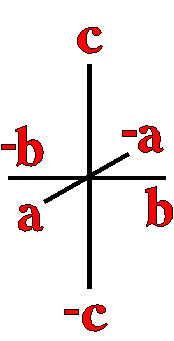
Orthorhombic V = abc
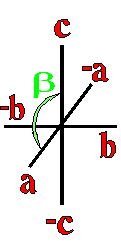
Monoclinic V = abc sin(β)
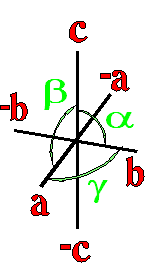
Triclinic V = abc ((1- cos2 α - cos2 β - cos2 γ) + 2(cos(α) cos(β) cos(γ))½

Where a, b, and c are the unit cell axes dimensions and α, β, and γ are the inclination angles of the axes in the unit cell.

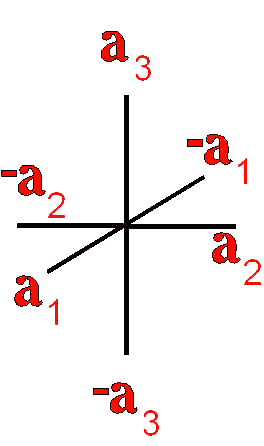
Isometric Tetragonal Hexagonal
Trigonal
Orthorhombic Monoclinic Triclinic

Den(Calc) =[Molecular Weight]*[Z])/([Volume]*0.60225)

Where:
Cell Volume is in Angstroms3
Z is in Formula Units per Cell
Molecular Weight is in grams/mole
Den(Calc) is in grams/cubic centimeter
and 0.60225 is the Avogadro constant / 1.0 x 1024 - note: (10-8 angstroms/centimeter)3

For Further Information on Unit Cell Dimensions

Search the Mineralogy Database

Match term in the Database:

Search the Web

Google
 
Web webmineral.com

University of Colorado Caution: Slow loading page.

Go To Webmineral Home Crystallography X-Ray D-Spacing Table Chemical Composition
Dana Classification Strunz Classification Table of Mineral Properties Alphabetical Listing of Minerals
Search Webmineral Photo Gallery of Mineral Images Help Files Links